- When the battery is repeatedly charged
- When the battery is used, charged or stored in a place with high temperature
Battery Power |
||||||||||||||||||||||||||
Important Battery TipsHow to use the battery with minimal deteriorationThe battery is a consumable
and, as such, its performance will gradually deteriorate. This
deterioration is accelerated under the following conditions.
To minimize deterioration of
the battery and ensure a longer battery life, you must reduce the number of
charges and ensure
that the temperature inside the battery does not become too high.
Bear in mind the following points.
Charge the battery in a temperature range of 10ºC to 30ºC {50ºF to 86ºF}In places where the outside air
temperature is high, the temperature inside the battery will also
become high. Do not charge the battery inside a vehicle with all its
windows closed and
exposed to the hot sun or in other places where the temperature is high.
This computer’s battery will not be charged if its temperature is outside the allowable range. (At such a time, the battery indicator blinks orange.) We recommend charging the battery no more than once per dayRecharging the battery after
every small use raises the total number of battery charges and speeds
battery deterioration.
To lower the total number of battery charges, we recommend recharging the battery no more than once per day or when the remaining charge drops to 10% or less. With this computer, in order to reduce the number of charges, the battery will not be recharged immediately after it has been fully charged unless the remaining charge has fallen to less than 95%. Charging the battery while the computer is powered off is recommendedIf the computer’s
power is on, the temperature inside the battery rises due to the
effects of heat from the CPU and other components. We recommend that
you only charge the battery when the computer is powered off.
Use the battery in the high temperature modeHigh temperature mode is a
function that prevents deterioration of the battery in high temperature
environments or when using the fully charged battery pack for a long
period of time.
When the high temperature mode is selected, the battery capacity is reduced, and therefore the battery operating time is shorter. We recommend the high temperature mode setting when the computer is to be used under the following conditions:
How to use the computer to maximize the battery operation timeLeave the computer off when it is not in useDecrease the internal LCD brightness by pressing «Fn» + «F1»Pressing
«Fn» + «F1» will lower the
degree of brightness, thereby reducing the power consumption.
Before stepping away from your computer, press «Fn» + «F7» or «Fn» + «F10» to put your computer in the sleep*1 or hibernation modePressing these key combinations
will put your computer in the sleep*1 or
hibernation mode, thereby lowering the power consumption.
*1 : Windows XP: standby
|
 or
or  in the notification area, and select a power plan that uses the
power-saving function.
in the notification area, and select a power plan that uses the
power-saving function.| Battery indicator | Battery status |
| Not lit | The battery pack is not inserted or not being charged. |
| Orange | Charging is in progress. |
| Green | The battery is fully-charged. |
| Blinking green | In High temperature mode, the battery pack is discharging the power to 80%*4 of the normal temperature mode. Do not remove the battery pack in this status. |
| Red | The remaining battery is approximately 9% or less. |
| Blinking red | The battery pack or the charging circuit is not operating properly. |
| Blinking orange | The battery cannot be charged temporarily due to
the following reasons:
|
*4 : In high temperature mode, the 100% battery level is equivalent to
80% level of the normal temperature mode.
NOTE
- Once the battery is fully
charged, the computer performs recharging only when the battery level
becomes less than approximately 95%, so overcharging is avoided.
- When [LED] is set to [OFF] on
the [Concealed Mode Configuration] menu, LED disappears.
Checking the Remaining Battery Charge
You can check the remaining battery charge on the screen.
(After logging on to Windows)
- Press «Fn»
+ «F9».
- When the battery pack is inserted (example)
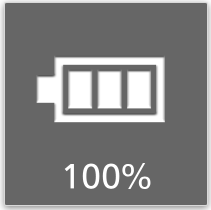 :
Normal temperature mode
:
Normal temperature mode
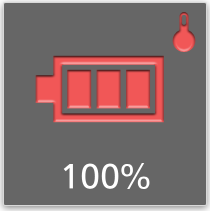 : High
temperature mode
: High
temperature mode
- When the battery pack is not inserted
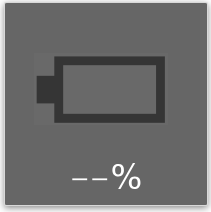
- When the battery pack is inserted (example)
NOTE
- The battery display may
not correspond to the actual remaining battery charge in the cases as
below. To correct the display, perform the Battery Recalibration
( Correcting
the Battery Display (Battery Recalibration)).
Correcting
the Battery Display (Battery Recalibration)).
Correcting
the Battery Display (Battery Recalibration)).- The battery indicator remains red.
- The indicator lights orange and the display shows 99% for a long time.
- Low battery warning appears soon after a short time
of use.
This can occur when the computer is in sleep*5 for a long time without power supply from the AC adaptor.
- The battery display may
not be the same as that of notification area*6.
This is not a malfunction.
*5 : Windows XP: standby
*6 : Windows XP: Or of [Power Meter] in [Power Options Properties]
*6 : Windows XP: Or of [Power Meter] in [Power Options Properties]
High temperature mode
The high temperature mode can prevent the battery from deteriorating
when the computer is used in high-temperature environment or used for a
long time with its battery fully charged.
Select [Auto] (default) or [High Temperature] in [Environment] of the [Main] menu of the Setup Utility.
Select [Auto] (default) or [High Temperature] in [Environment] of the [Main] menu of the Setup Utility.
NOTE
- Note that a level
corresponding to a 100% charge for high temperature mode is
approximately equivalent to an 80% charge level for normal temperature
mode.
- After switching from
[Normal Temperature] to [High Temperature] or vice versa, the remaining
battery capacity will not be displayed correctly until the battery pack
is completely discharged or fully charged.
- In the [Auto] mode:
Once the computer has automatically switched from the normal temperature mode to the high temperature mode, the computer will not switch back to the normal temperature mode until the battery has been used and recharged to a total charge level of about 5 times as much as that of the fully-charged state. This is to avoid battery deterioration.
Once the computer has automatically switched from the normal temperature mode to the high temperature mode, the computer will not switch back to the normal temperature mode until the battery has been used and recharged to a total charge level of about 5 times as much as that of the fully-charged state. This is to avoid battery deterioration.
Computer behavior with low battery
The default settings are as follows.
| When
the battery level becomes 10% [Low battery alarm] |
When the battery level becomes 5% [Critical battery alarm] |
|


|
| ↓ | ↓ |
| Charge the battery. | Connect the AC adaptor or replace the battery to start up the computer. |
|
|
Correcting the Battery Display (Battery Recalibration)
The "Battery Recalibration" function measures and
memorizes the battery capacity. To correct the battery display, use
this function to fill the battery and then discharge it completely.
Perform the procedure at least once immediately after purchasing the
computer. Normally the interval of battery recalibration is 3 months.
The battery display may not be correct when the battery pack
deteriorates after a long time use. In this case, perform the procedure
again.
- Connect the AC adaptor.
- Close all the applications.
- Perform "Battery Recalibration".
- Click
 (Start)*7 - [All Programs] - [Panasonic] -
[Battery] - [Battery Recalibration].
(Start)*7 - [All Programs] - [Panasonic] -
[Battery] - [Battery Recalibration]. - When the confirmation message appears, click
[Start].
- Frequent recalibration of the battery can degrade the battery. A caution message appears when the battery recalibration is performed at the shorter interval than approximately a month. In this case, cancel the battery recalibration.
- When the message requests shut down of Windows,
click [Yes].
The battery recalibration starts.
After the battery pack is fully charged, discharging starts. When the discharging is completed, the power goes off automatically.
After the battery recalibration is finished, normal charging starts. - Click
*7 : Windows XP: [start]
NOTE
- The temperature range
should be 10ºC to 30ºC {50ºF to
86ºF}.
- The battery recalibration
may take a long time due to the large battery capacity. This is not a
malfunction.
- Full charge: Approximately 2 hours (with CF-VZSU71U)/1.5 hours (with CF-VZSU72U)
- Complete discharge: Approximately 2 hours (with CF-VZSU71U), 1.5 hours (with CF-VZSU72U)
- If the computer is turned
off during the battery recalibration (e.g., due to power failure, or
accidental removal of the AC adaptor and battery pack), the battery
recalibration will not be completed.
- You can also perform the
battery recalibration with the following procedure.
- Restart the computer.
- Press and hold «F9» while the [Panasonic] boot screen is displayed just after the computer starts the startup procedure.
- When the remaining battery capacity is displayed, press «Enter».
- Follow the on-screen instructions.
Replacing the Battery Pack
The battery pack is a consumable item so the
replacement will be necessary. If the battery operation time becomes
noticeably short and not recovered even after recalibrating the
battery, replace with a new battery.
CAUTION
- The battery pack is not
charged when you first purchase it. Be sure to charge it before using
for the first time. Charging starts automatically when the AC adaptor
is connected to the computer.
- Use only the specified
battery pack with your computer.
- In sleep*8,
do not remove/replace the battery pack. Otherwise your data will be
lost and the computer may be damaged.
- Turn off the computer.
- Do not use the sleep*8 function.
- Reverse the computer and remove the cover.
- Press and hold the
 mark part (A) and slide the cover to remove.
<CF-53 Series><CF-52 Series>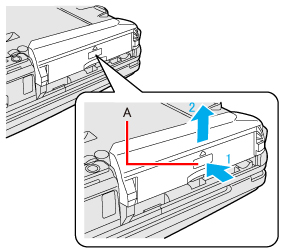
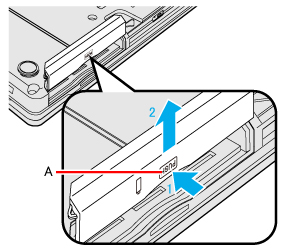
- Press and hold the
- Remove/Insert the battery pack.
- To remove
Slide and hold the latch (B), and pull the tab (C) of the battery pack.<CF-53 Series><CF-52 Series>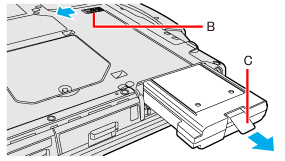
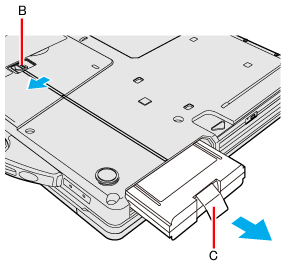
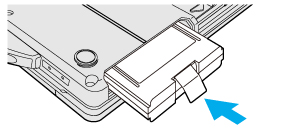
- To insert
Insert the battery pack until it securely fits the connector.<CF-53 Series><CF-52 Series>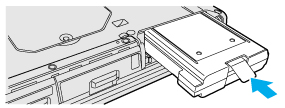
- To remove
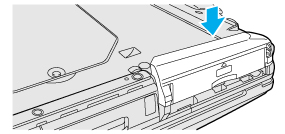
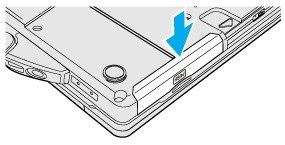
- Slide the cover back.
Push the cover until it clicks.<CF-53 Series><CF-52 Series>
CAUTION
- Make sure the latch is
securely locked, otherwise the battery pack may fall when you carry the
computer.
- Do not remove the battery
pack forcibly when the latch is locked. Doing so may damage the battery
pack.
*8 : Windows XP: standby